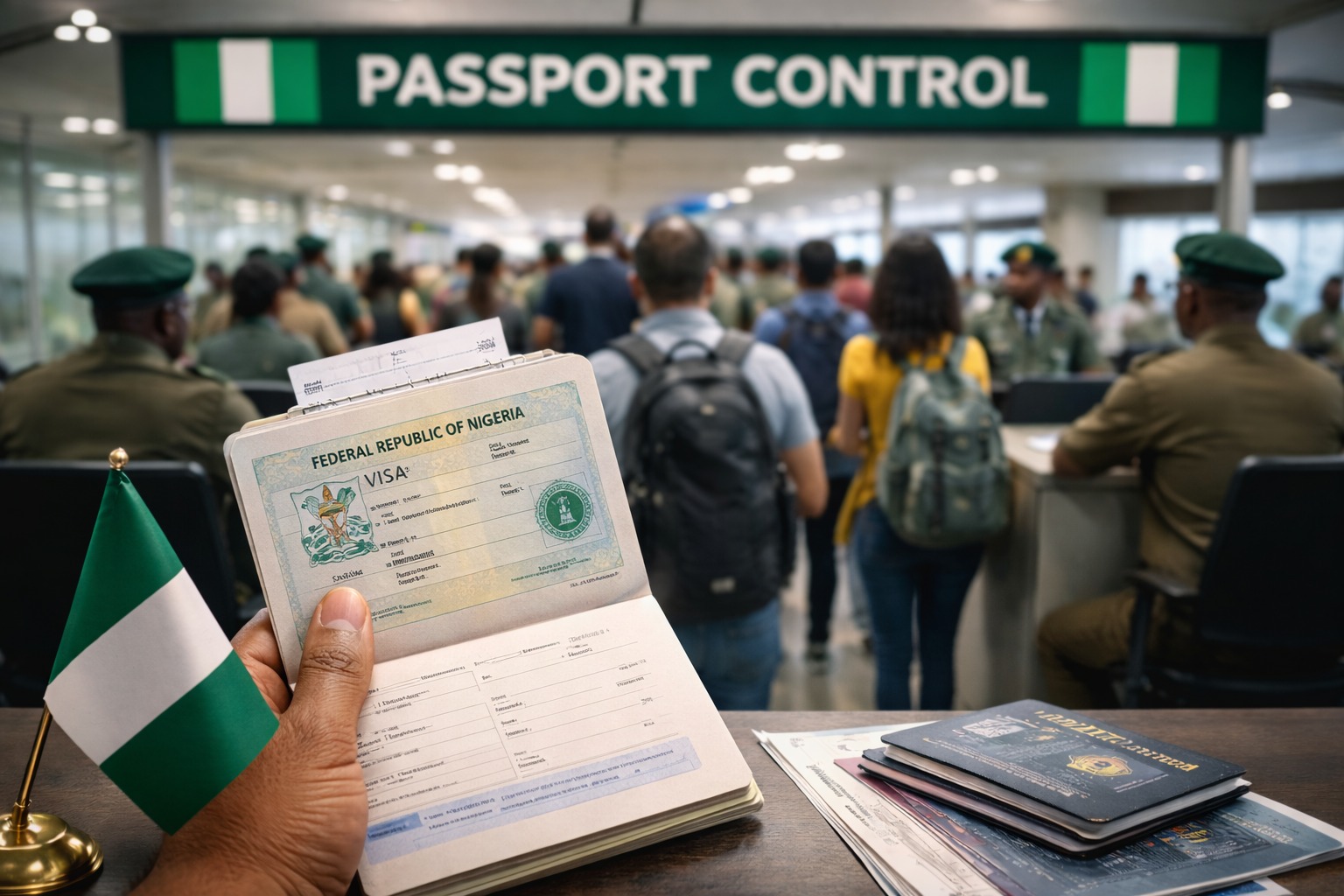
Every December, a familiar migration pattern repeats itself.
Flights land. Accents resurface. Exchange rates become dinner-table conversation. Cities like Lagos transform into pressure cookers of money, movement, culture, resentment, and performance. And into this combustible mix walks the character we’ve collectively named — sometimes mockingly, sometimes wistfully — the IJGB: “I Just Got Back.”
This year, Nigerians online coined an upgrade: IJGB SLR — “I Just Got Back, Still Learning Reality.”
Because the reality has gotten heavier.
December is no longer just a festive season. It has become a live-action social experiment, revealing hard truths about inequality, belonging, identity, and the unspoken class system that shapes life in modern Nigeria. And what once felt like reunion now often feels like surveillance — of wallets, of accents, of intentions, of belonging itself.
The Currency Hierarchy — and the Quiet Humiliation Beneath It
Let’s say the quiet part out loud:
Nigeria now runs a December dual-economy. One economy prices in naira. The other prices in — or because of — dollars.
A meal costs one thing until an accent appears. A short-let jumps from ₦250k to ₦1.2m because the market believes “December money is not real money.” Services become vibes-priced. The city bends toward whoever holds the strongest currency — not because locals are greedy, but because survival has math.
But when naira stops being “enough,” dignity becomes collateral.
Class Is No Longer Subtle — It’s a Spectator Sport
Detty December has turned class into performance theater.
Who gets waved past the rope.
Who knows the promoters personally.
Who can get home safely at 3am.
Who must decide between groceries and a single night out.
Locals feel displaced in their own city. Diasporans feel othered in the place they still call home. And both sides are right.
Because this isn’t about envy — it’s about asymmetry. One group can leave. The other cannot. That difference now sits at the center of the December mood.
Viral TikToks, Exaggerated Accents, and the Performance of Belonging
Social media has turned IJGB culture into a meme category. Fake posh accents. “What do you mean POS is not working?” skits. Content houses turning frustration into reels. IJGB mockery is now both comedy — and quiet retaliation against perceived superiority.
Meanwhile, IJGBs say they feel like prey:
Priced differently. Watched differently. Loved — but also leveraged.
It’s a cycle of irony: diasporans perform belonging to prove they’re still Nigerian; locals interpret that performance as proof that they are not.
When Everyone Feels Exploited, Trust Collapses
Inflated pricing used to be “banter." Now it feels like policy. Bills shock even dollar-earners. Card terminals mysteriously “stop working.” Vendors reject foreign cards to avoid chargebacks. Trust — the invisible infrastructure powering any economy — is breaking down.
And when trust erodes, resentment fills the gap. Which is why this year has felt particularly confrontational. Arguments at gates. Online draggings. A public mood that increasingly whispers: “We love you — but we resent what your presence does to the market.”
Even IJGBs Are Saying: “This Is Too Much”
For many diasporans, December is supposed to be emotional homecoming — a reconnection, a reset, a soft landing into familiarity.
Instead, it becomes: Daily requests, family dependency spiraling into obligation, an unspoken expectation that foreign income = endless generosity and a social tax disguised as love.
Gratitude becomes assumed. Boundaries feel like betrayal. So home becomes both sanctuary — and burden.
⸻
Traffic, Chaos, and the Infrastructure Lie
Yes — IJGBs amplify demand.
But the real villain is weak infrastructure that cannot scale.
Traffic exposes that truth ruthlessly. 
When systems fail, people blame the most visible thing.
In December, that’s the IJGB.
⸻
From “Help Me” to “Please Leave Me Alone”
There’s now a predictable emotional arc:
Arrival — warmth, laughter, nostalgia
Middle — overwhelm, pressure, emotional taxation
End — fatigue, withdrawal, misunderstanding
Proximity during December accelerates every tension. 
⸻
So… What Is IJGB SLR Really About?
It’s a stress-test of identity and economy.
It exposes:
• how currency shapes dignity
• how class lines redraw themselves overnight
• how belonging becomes performance
• how support becomes expectation
• how fragile trust now is
• how badly our systems need modernization
And this matters because return migration is not a December fluke anymore. It’s structural. People will keep moving — for work, for school, for opportunity — and coming home again. 
Movement is now a permanent feature of Nigerian life.
And movement requires infrastructure.
⸻
Where VOYA Sits in This Conversation
At VOYA, we don’t romanticize movement — we study it.
Visas. Borders. Security. Remittances. Travel churn.
The emotional labor of migration.
The financial distortions migration creates.
We exist because emerging-market travelers deserve clarity, structure, fairness, and dignity — wherever they’re coming from, and wherever they’re going.
And because the world is already judging African travelers enough — home shouldn’t feel like another test.
⸻
Detty December Isn’t the Problem — It’s the Mirror
IJGB SLR isn’t an attack.
It’s an invitation to look honestly at the system we’ve built:
A system where money outruns empathy.
Where class anxiety masquerades as humor.
Where infrastructure fails — so people blame each other instead of the system.
Where “home” feels increasingly conditional.
December didn’t create these tensions.
It simply turns the volume all the way up.
And until currency stabilizes, infrastructure strengthens, financial trust rebuilds, and class becomes less fatalistic — December will keep reminding us. Loudly.
Because IJGBs are not the disruption.
They are the data point.
And the country is the experiment.
The question is whether we are ready to run it better next year.