
How a Cultural Season Became Nigeria’s Most Powerful Economic Engine
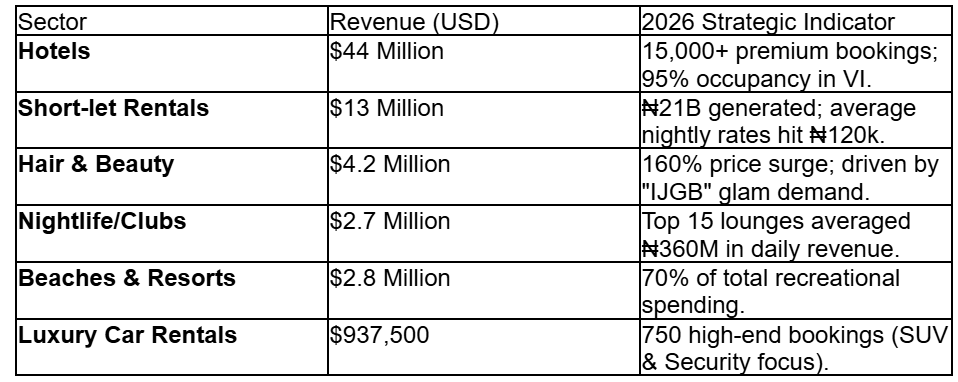
The “Detty December” phenomenon has matured from a cultural trend into Nigeria’s most significant seasonal economic engine. By analyzing the $71.6 million (₦111.5 billion) benchmark set in the 2024/2025 season, we can see how the festive economy now dictates national fiscal performance and travel policy for 2026.
The Macro Impact: VAT & Employment
While individual spending grabbed the headlines, the systemic impact on Nigeria’s tax revenue was the season’s headline story.
- VAT Revenue Surge: By month-end, VAT collection in December 2025 reached an estimated ₦700–720 billion, significantly outperforming the 2025 monthly average of approximately ₦680 billion.
- Fiscal Pillar: This spike ensured that Q4 alone accounted for roughly 25–29% of annual VAT revenue, proving that “Detty December” is a critical pillar of Nigeria’s diversification strategy.
- Job Creation: Temporary employment rose significantly, with 15,000–20,000 short-term jobs created across the event, security, and hospitality sectors an 18–25% increase over the standard monthly average.
Tourism & Arrival Numbers
Lagos solidified its position as Africa’s premier festive destination, seeing massive international and domestic traffic.
- Air Traffic Milestone: Murtala Muhammed International Airport (Lagos) ranked as the 6th busiest in Africa in December 2025, handling 485,005 departing seats.
- The “IJGB” Factor: Roughly 90% of international arrivals were Nigerians living abroad returning from the USA, UK, and Canada.
- Domestic Shifts: While international travel peaked, domestic passenger traffic saw a slight slump due to rising local airfares, leading many to opt for road travel for regional festivals.
- POS & Digital Retail: POS transaction volumes hit record highs, roughly 25–30% higher than average months as returnees avoided cash, fueling a massive spike in electronic VAT collections.
The Economic Breakdown: Where the Money Flowed
The 2025 audit shows that spending is no longer just about concerts; it is a total ecosystem play involving hair, transport, and digital retail.
The “December Premium”: June vs. December 2025
For returnees, the “holiday tax” is a measurable shift in the cost of living.

Systemic Friction: E-Visa Failures & 2026 Rules
While the economy thrived, the 2025/2026 season was marred by technical barriers and stricter mobility compliance.
- Portal Crashes: The Nigeria e-Visa portal struggled with high holiday traffic, leading to “payment black holes” and unprocessed applications.
- Deportation Risk: Travelers without the new mandatory Digital Landing Cards faced immediate deportation or $15/day overstay fines.
- The 2026 US Visa Bond: As of January 21, 2026, certain Nigerian B1/B2 applicants must now post refundable bonds of $5,000–$15,000 to ensure visa compliance.
The VOYA Position: In an environment of technical instability and strict enforcement, VOYA serves as the essential insurance policy and digital mobility infrastructure for the modern traveler.
Common Questions About Detty December 2025
How much did Lagos make from Detty December? The state generated over $71.6 million in direct revenue from the 2025 festive season across tourism, hospitality, and entertainment.
What are the requirements for a Nigerian e-Visa? You need a valid passport (6 months), a return ticket, proof of funds, and a confirmed hotel reservation or invitation letter. Applications are strictly online.
How busy was the Lagos airport in December 2025? It was the 6th busiest in Africa, with 485,005 departing seats recorded by the Official Airline Guide (OAG).
Does VOYA help with these new visa bonds? While VOYA specializes in streamlining the e-Visa and documentation process, the new US Visa Bond is a direct requirement from the US Department of State for specific applicants.
Page Summary: This report provides the definitive economic and tourism numbers for Nigeria’s Detty December 2025, detailing the revenue milestone, record airport traffic, and the transition to the 2026 e-Visa and US Visa Bond systems.